Executive Summary
Introduction: The Consequences Of Action Can Be Categorized By Its Level Of Impact
"Understanding Climate Change Through Communication And Collaboration" presents a detailed analysis of communication and collaboration roles in understanding and addressing climate change. It explores discourses of delay and outlines a proposal for developing a unified language for climate change discussion while acknowledging the challenges in formulating shared narratives. The paper offers a solution to these challenges, arguing that we can proactively address the climate crisis through inclusive and productive dialogue.
As Earth's inhabitants, we are urged to navigate our future toward a cleaner, efficient, and inclusive society. Our words, narratives, and discourses impact and influence the rate of change, whether delay or progress. Narrative discourses of delay restrict or divert movement to maintain conditions supporting profitability and perpetual growth, disregarding the damaging results and environmental effects level of impact.
We aim to construct a flexible, multifaceted, and interdisciplinary language model. This model leverages ethos, pathos, and logos to define inclusive, simple, unified theories, concepts, and definitions. The purpose of this model is to support informed decision-making, acting as a comprehension aid for understanding the narrative divergence of climate change counter-movement organizations from empirical evidence and ethical standards.
Understanding Climate Discourses
EcoVerse, functioning as an international climate communication orchestration (service), proactively engages in collaborative, communal, and coordinated endeavors to deconstruct and disprove misleading narrative arguments that obfuscate climate change. Our facilitative approach (strategy) of responsibility (task) and accountability (execution) drives normative shifts (action) to mitigate climate change impacts (goal).
Shared Language, Shared Understanding: Navigating Climate Change Through Collaborative Linguistic Narratives

Image And Text Source: Hildebrand, Linda. (2017). Strategic investment of embodied energy during the architectural planning process. A+BE: Architecture and the Built Environment. 4. 10.7480/abe.2014.5.
Challenges Of A Shared Narrative
Developing a shared narrative for a complex issue like climate change is fraught with obstacles, including the politicization of climate science, cultural and cognitive biases, media misinformation, and unequal representation of stakeholder groups. Overcoming these challenges requires acknowledging and navigating these complexities and fostering an informed and inclusive dialogue.
Conclusion: Enabling Restorative Justice For FATE
(Fairness, Accountability, Transparency, and Ethics)
EcoVerse is an accountability mechanism model that evaluates logic and develops empirically grounded theories of sense by deconstructing narrative arguments for inconsistencies and exposing biases that obstruct sustainability. Our facilitative approach of responsibility and accountability drives normative shifts to mitigate climate change impacts.
Interconnectedness defines Earth's ecosystems and should characterize our narrative too. Disruptions from climate change, such as melting glaciers, rising sea levels, and flooding, perpetuate food and water insecurity, unemployment, loss of livelihoods, poverty, escalating healthcare inaccessibility, conflict, war, and forced migration. We must continue innovating science communication with interdisciplinary approaches, creating spaces for informed and inclusive dialogues that adhere to Fairness, Accountability, Transparency, and Ethics (FATE) principles. Our initiative calls for unity in depoliticizing climate science narratives and a collaborative commitment to restorative justice in securing a sustainable future with the end goal in mind that inhabitants of Earth thrive and survive.
Understanding Climate Change Through Communication And Collaboration
Part I: Introduction
Do you believe climate change is real and that we are experiencing climate change now? Or that we should design a path toward an efficient, cleaner, and inclusive society for the future success of all of Earth's inhabitants? Do you believe that words can be used for good or bad? Let us discuss how narratives affect progress focusing on discourses of delay disguised as concern and progress, operating as non-transformative solutions to champion optimism while promising miracle breakthroughs. These discourses may be captivating and inspirational, yet they distract from the urgency needed for immediate actions and practical solutions while narrowly defining what climate success is.
This paper is a vital resource and is considered an aid for understanding and promoting informed decision-making through a multipronged interdisciplinary approach focusing on a productive discourse of responsibility to develop unbiased, uniform linguistic narratives concerning climate change. The goal is a precise language that all audiences can digest and understand to develop unified theories, concepts, and definitions resulting in an inclusive, transparent, simple, and honest shared language. Our appeal to ethos, pathos, and logos uses sociological methods to examine how climate change counter-movement organizations deviate from empirical evidence and ethical standards while engaging directly with communities at the local, focusing on climate communication with a significance placed on the deficit behavior that discourages climate action by fostering two-way communication for critical engagement directly with communities at the local and international levels. The writing below is a fictional example of how such goals may be met.
Part II: Understanding Climate Discourses
EcoVerse is an international climate communication hub dedicated to using collaborative efforts to develop unified theories, concepts, and definitions resulting in inclusive shared language to debunk misleading and incoherent arguments that downplay climate change. Our multipronged interdisciplinary approach to science communication focuses on a productive discourse of responsibility with attention on the collective potential of individual actions and actors to stimulate normative shifts building pressure towards regulation, recognizing that regulations and structural shifts are complementary to supporting individual behavior change. For critical engagement with such discourses, our strategy involves up-skilling and engaging directly with communities at the local and international levels while creating and promoting access to public deliberation as an inclusive, unbiased de-escalation effort to genuinely address climate change narratives without attacking the individuals behind the narratives. Our research methods focus on the human behavior aspect of climate communication utilizing qualitative and quantitative empirical evidence to analyze patterns in the communication of written text, spoken words, and images to identify shared features of climate delay narratives. At a minimum, success would be marked by an enhanced understanding of climate delay narratives and increased public interest in climate action. Our ultimate goal is to develop an unbiased, uniform linguistic narrative from empirical evidence to deliver clearly defined evidence-based narratives of climate change delay, debunking climate myths and misinformation, resulting in action and appropriate solutions of scientific merit, heuristic value, withstanding government debate, and public scrutiny.
To develop an unbiased, uniform linguistic narrative, we focus on climate delay discourses such as individualism, whataboutism, technological optimism, all talk and little action, fossil fuel solutionism, no sticks just carrots, appeal to social justice, appeal to well-being, policy perfectionism, change is impossible, and doomism. (See Figure 1) Technical research methods include and are not limited to; Quantitative Text Analysis: an automated, systematic method for processing extensive amounts of text, helping us identify shared elements of climate delay narratives; Systematic Review and Meta-Analysis: which allows us to collect, summarize, and analyze empirical evidence; Content Analysis: to detect patterns in written text, spoken words, and images then analyze patterns to understand climate discourse better. Grounded Theory: develops theories focusing on real-world contexts through data collection and analysis; Lastly, Analysis of Social Deviance: uses sociological methods to examine how climate change counter-movement organizations deviate from empirical evidence and ethical standards to identify the impacts of climate delay discourses (see Fig.1).
We are responding to a deficit in that our approach serves as an innovative model for science communication utilizing a unified and coherent language to promote public understanding to address complex and politicized climate change issues. The deficit is characterized by interest groups and stakeholders using narrative influence on public behavior to discourage climate action and avoid government policies that will result in profit loss. We strive to develop and foster an inclusive environment where everyone is heard and respected to stimulate proactive discourse through an informed public narrative to inspire a global shift towards sustainable practices meeting Corporate Social Responsibility (CSR) and Environmental, Social, and Governance (ESG) standards.
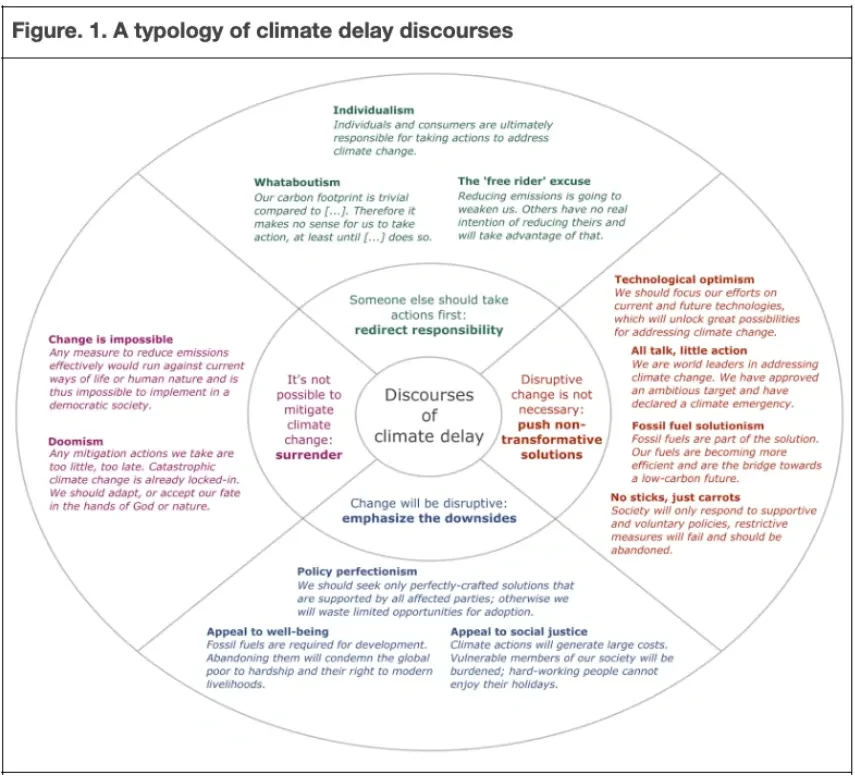
Image Source: Lamb WF et al. (2020). Discourses of climate delay. Global Sustainability 3, e17, 1–5. https://doi.org/10.1017/sus.2020.13
Part III: Challenges Of A Shared Narrative
Developing a shared narrative is challenging in a field as complex and polarizing as climate change. Primary obstacles include the politicization of climate science, cultural and cognitive biases, media dissemination of misinformation, and the unequal representation of stakeholder groups. The politicization of climate science creates a deeply divided audience, where climate change narratives are not assessed based on their scientific merit but on their alignment with political ideologies. This polarizing environment poses significant challenges to developing and disseminating a shared, evidence-based narrative. In this context, the message becomes entangled with the messenger, undermining its credibility and effectiveness.
Cultural and cognitive biases further complicate the narrative. Cultural biases relate to how different cultures understand and respond to climate change. Cognitive biases, on the other hand, refer to the mental shortcuts people use to make sense of complex information. For instance, the optimism bias can lead people to underestimate the seriousness of climate change, while the confirmation bias can cause them to selectively attend to information that confirms their pre-existing beliefs. Both biases can significantly skew the public's understanding of climate change and impede the acceptance of a shared narrative.
Media dissemination of misinformation is another hurdle. Despite numerous scientific consensus on the reality and severity of climate change, some media outlets continue to promote climate change denial narratives. These narratives can perpetuate a false sense of debate, create public confusion, and ultimately delay climate action.
Lastly, the unequal representation of different stakeholder groups in developing climate change narratives presents a challenge. Perspectives from the Global South, indigenous communities, and other marginalized groups are often underrepresented. This omission not only hampers the inclusivity of the narrative but also overlooks the unique experiences and insights these groups bring to the table. Fig. 2: Classification Of Contrarian Claims About Climate Change represents climate change narratives that challenge how climate change counter-movement organizations deviate from empirical evidence.
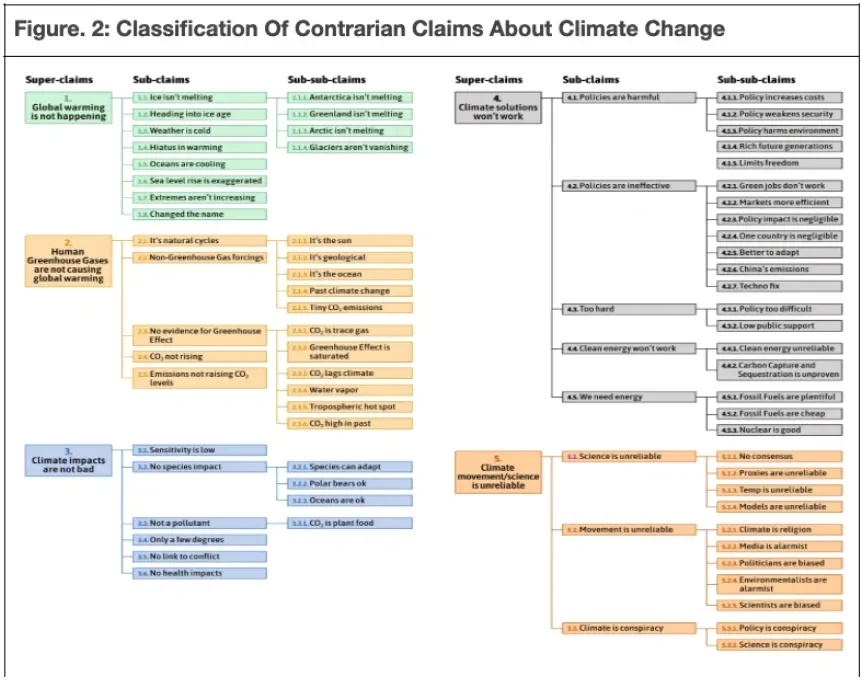
Image Source: Coan, T.G., Boussalis, C., Cook, J. et al. Computer-assisted classification of contrarian claims about climate change. Sci Rep 11, 22320 (2021). https://doi.org/10.1038/s41598-021-01714-4
Part IV: Conclusion
The fight against climate change is not just a scientific endeavor—it is a communicative one. How we talk about climate change shapes how we understand it and, in turn, how we act upon it. Overcoming the challenges of crafting a shared narrative requires us to acknowledge and navigate the complexities of climate change communication. It demands that we bridge political divides, consider cultural nuances, correct cognitive biases, counter misinformation, and prioritize inclusive representation. To do this, we must continue to innovate in science communication, adopting interdisciplinary approaches and creating spaces for productive, informed, and inclusive dialogues. Figure 3: Shared Narrative visually represents how little of a shared narrative passes between climate change believers and deniers; we speak two different languages when addressing climate.
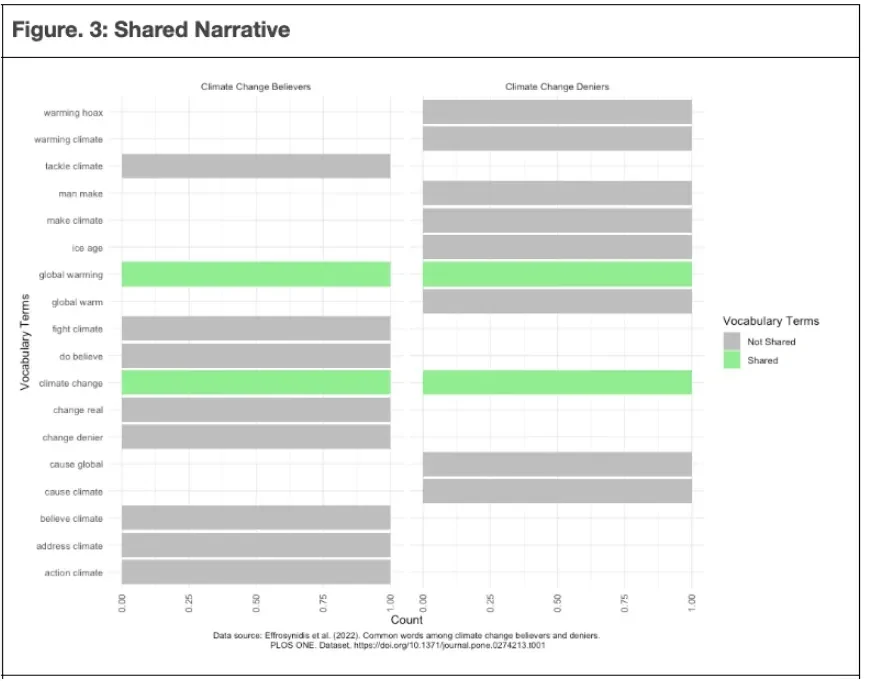
**Note: The data used for Figure 3: Shared Narrative was derived from "Effrosynidis et al. (2022). Common words among climate change believers and deniers." This data was reprocessed and visualized by Selena Scola using RStudio. The original dataset underwent significant reprocessing to fit the context of this paper, and thus the representation in Figure 2 should not be taken as indicative of the original dataset.
The stakes are high, but the promise of a more informed and unified response to climate change makes the challenge worth taking on. In the words of conservationist Rachel Carson, "In nature, nothing exists alone," (Carson, 2002) just as our planet's ecosystems are interconnected, so too must our efforts be to address the global climate change crisis. Let our narrative be one of responsibility, unity, and focused on action as we face one of humanity's most significant challenges, finding solutions to climate change before the damage to Earth and our shared environment is irreparable, as hope alone will not ensure a sustainable future for all of Earth's inhabitants.
For Print
"Shared Language, Shared Understanding: Navigating Climate Change Through Collaborative Linguistic Narratives" suitable for publication in a peer-reviewed academic journal focused on the social, economic, and political dimensions of global environmental change, including climate change. Such journals include Global Environmental Change, Environmental Communication, Climatic Change, Nature Climate Change, and Journal of Environmental Studies and Sciences.
Purpose
EcoVers is an endeavor to address the challenges of climate change communication advocating for a unified and inclusive narrative by depoliticizing climate science, encouraging responsible global practices, and embracing restorative justice. The objective is to inspire action and facilitate an informed and cohesive response to the climate situation, ensuring a sustainable future for all.
Audience
The target audience for this paper includes environmental scientists, communication scholars, policymakers, educators, activists, and anyone engaged in climate change discussions. The paper could also be useful for businesses and institutions looking to improve their sustainability initiatives.
Rhetoric:
Narratives shape climate change discourse and action.
Critique of "discourses of delay" and their hindrance to progress.
Proposes a unified language model to guide climate change discussions effectively.
Outlines the necessity of adhering to FATE (Fairness, Accountability, Transparency, and Ethics) principles.
Concludes with an urgent call to action for developing responsible, unified solutions to climate change.
Key Points to Remember:
A unified language model is crucial for understanding and addressing climate change.
A shared narrative faces hurdles like politicization, biases, misinformation, and unequal representation.
Innovation in science communication, adhering to FATE principles, is needed for a sustainable future.
Citations And Figures
Hildebrand, L. (2017). Strategic investment of embodied energy during the architectural planning process. A+BE: Architecture and the Built Environment. 4. 10.7480/abe.2014.5.
Lamb, W., Mattioli, G., Levi, S., Roberts, J., Capstick, S., Creutzig, F., . . . Steinberger, J. (2020). Discourses of climate delay. Global Sustainability, 3, E17. doi:10.1017/sus.2020.13
Figure 0. Strategic investment of embodied energy during the architectural planning process - Scientific Figure on ResearchGate. Available from: https://www.researchgate.net/figure/Consequences-of-an-action-can-be-categorized-by-its-level-of-impact-The-level-is-defined_fig3_289741225 [accessed 15 Jul, 2023]
Figure 1. Image Source: Lamb WF et al. (2020). Discourses of climate delay. Global Sustainability 3, e17, 1–5. https://doi.org/10.1017/sus.2020.13
Figure. 2: Image Source: Coan, T.G., Boussalis, C., Cook, J. et al. Computer-assisted classification of contrarian claims about climate change. Sci Rep 11, 22320 (2021). https://doi.org/10.1038/s41598-021-01714-4
Figure. 3: Data source: Effrosynidis et al. (2022). Common words among climate change believers and deniers. PLOS ONE. Dataset. https://doi.org/10.1371/journal.pone. 0274213.001
Carson, R. (2002). Silent Spring. Houghton Mifflin Harcourt. (Original work published 1962)