Exploring The Evolution Of Pandemic Narratives
Content Warning: If you have been impacted by the COVID-19 pandemic, you may find this paper to be triggering.
F.A.T.E(Fairness, Accountability, Transparency, and Ethics) Disclaimer For Potential Of Bias In This Paper As of 03/09/2022:
While all efforts have been made to write this paper objectively, this paper may contain the following biases:
Scola identifies as a liberal U.S. citizen; Has a conflict of interest with Facebook; Believes that the incarcerated should have free high-quality healthcare, access to academic education, that workers' rights are human rights whether incarcerated or not, that bed guarantees are exploitative to prisoners, and a living wage should be paid for prison labor; Is against ageism; Has provided healthcare services through the IHSS.gov (In-Home Supportive Services) during the pandemic; Is an elder advocate; Has experience utilizing behavioral targeting for industry profits.
Exploring The Evolution Of Pandemic Narratives
Keywords: COVID-19, coronavirus, pandemic, narrative, cultural evolution, incarceration, healthcare worker, Facebook, AARP
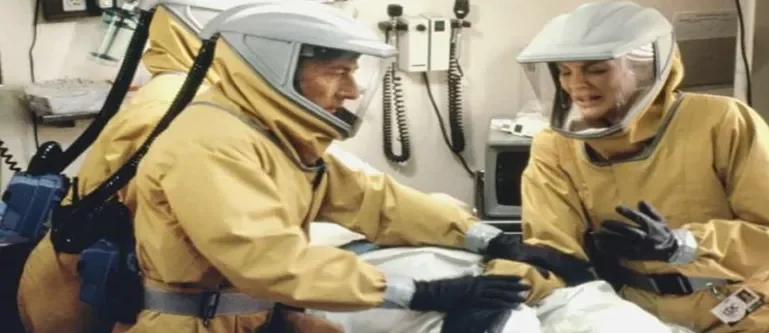
A scene from the 1995 film "Outbreak."
Introduction
The world was unprepared for COVID-19, a pandemic that quickly gave way to global disruption. Humans rapidly responded and adapted to unexpected events and changes in their environments as new narratives captured the world's attention. Narratives of uncertainty, fear, and panic were followed by narratives of distrust in experts, disinformation, and politically driven propaganda. Did the impacts of the pandemic cause our cultural narrative to rapidly evolve? Let us explore this further.
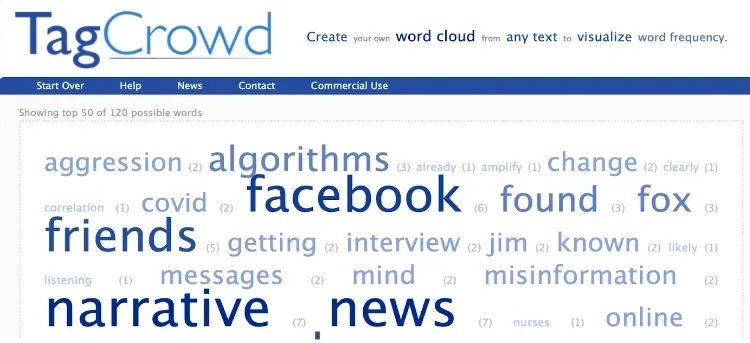
Screenshot of TagCrowd processed paragraph word frequency.
Image Credit: Selena Scola
Culture and Film Narratives
Do we have COVID-19 narratives? If yes, were they already at play as part of our culture? In the beginning days and weeks of the 2020 COVID-19 global pandemic, fans of apocalyptic fiction films such as 28 Days Later (2022) and Outbreak (1995) most likely watched in horror as their favorite film fiction narratives came to life. Priscilla Wald (2008) coined “outbreak narrative” to explain apocalyptic film narratives and their impact not only on the survival of the individual in times of crisis but also on the survival of the masses, especially during the beginning stages of a pandemic. What is an apocalyptic fiction film narrative?
Simply put, nothing good is to come of this; governments will topple, the economy will collapse, people will begin to loot businesses for supplies, buildings and neighborhoods will be abandoned, and riots will break out in the streets during and after lockdowns. You will be separated from your families as the contaminated, and the sick are forcefully sorted from the healthy. That the sick and contaminated are likely to die in a catastrophic manner, that they are dead already even though they are still living, that nothing can be done to save the infected or those who have come in contact with the infected, and you will never see your loved ones again. Unfortunately for many people around the world, the narrative horrors expressed in apocalyptic film fiction were a chilling and accurate description of their real-life experiences.
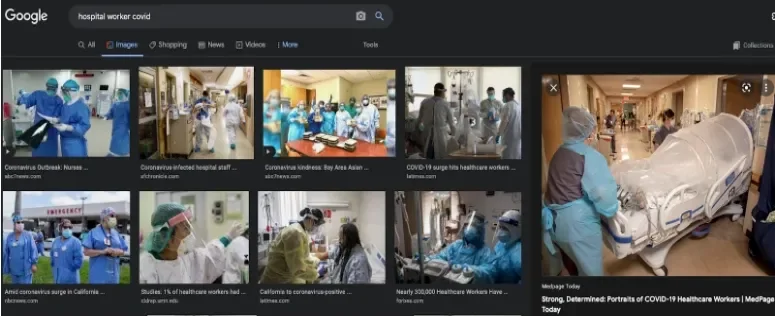
Google Images: Google search, "hospital worker covid"
Culture And Healthcare Narratives
Healthcare workers, in-home assistance providers, nurses, doctors, and other essential workers have had a very difficult and different pandemic compared to those of us who were healthy and sheltered in place. They dealt with "traumatic patient experiences," unjust "distribution of effective personal protective equipment" (Heath, C., Sommerfield, A., & von Ungern-Sternberg, B. S., 2020) and anxiety, along with unhealthy working conditions as they placed themselves at risk of contracting COVID-19 daily. During the first few months of the pandemic many around the world were uncertain as to what COVID-19 was. A senior physician in an ICU (intensive care unit) expressed fear and uncertainty as she was constantly calling her "colleagues in the country and around the world" (Daphna-Tekoah S., 2020) for information or new insights. "Sharon, a nurse… Corona—it is not extra work, it is completely different work" (Daphna-Tekoah S., 2020) as many healthcare workers were under constant fear and anxiety that they themselves would become infected or that they would infect loved ones or friends. "Golda, a nurse, described the traumatic moments after a patient's death" (Daphna-Tekoah S., 2020) as horrifying, as she wrapped deceased patients in two body bags instead of the usual one-body bag that she was trained for and accustomed to.
Many healthcare workers underwent a change in their internal narrative voice as their "You Voice, a voice that enabled the HCW's (healthcare workers) to distance themselves from recurring exposure to traumatic and painful experiences" (Daphna-Tekoah S., 2020) rapidly evolved under the unusual circumstances of COVID-19 unknowns. Many shifted their internal narrative to adapt to the demanding and challenging changes within their environment while continuing to function and provide for strangers, as they themselves were under life-threatening and uncertain circumstances.
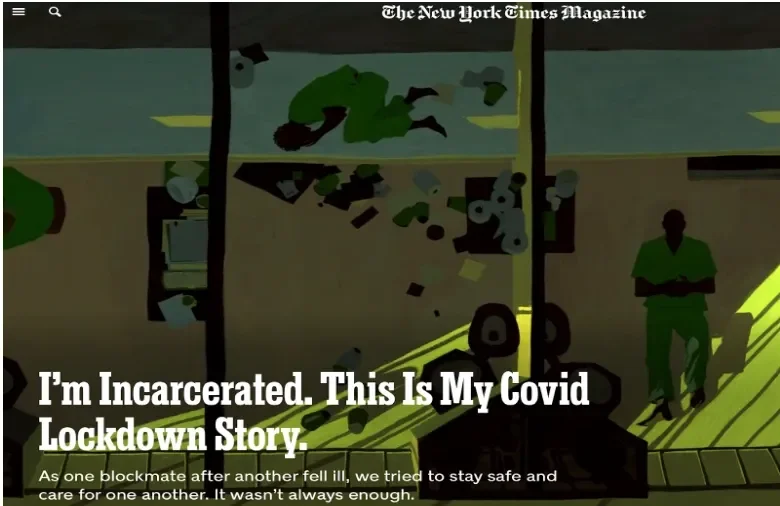
Illustration by Katherine Lam via The New York Times Magazine
Culture And Narratives Of The Incarcerated
"When Covid arrived in the United States… I was incarcerated in Westchester County, one of the pandemic's first hot spots, at Sing Sing Correctional Facility" (John J. Lennon 2021). Prisoners did not have access to face masks as COVID-19 surged at an unprecedented pace through prison facilities around the US. Inmates were not regularly tested for COVID-19, and they were ineligible for the vaccine when it became available to the general public in the US. Some measures were taken to keep the infected separated from the general population, yet fellow inmates working directly with the infected, serving food, and cleaning up garbage marked at the time as hazardous waste would return to the general population unvaccinated and also without being tested. A narrative of less than undeserving of equal access to a life-saving vaccine or "left without protection from infection" (John J. Lennon 2021) accompanied by a narrative of being punished led to an overall narrative of depression, skepticism, fear, and uncertainty as inmates and officers passed away from COVID-19.
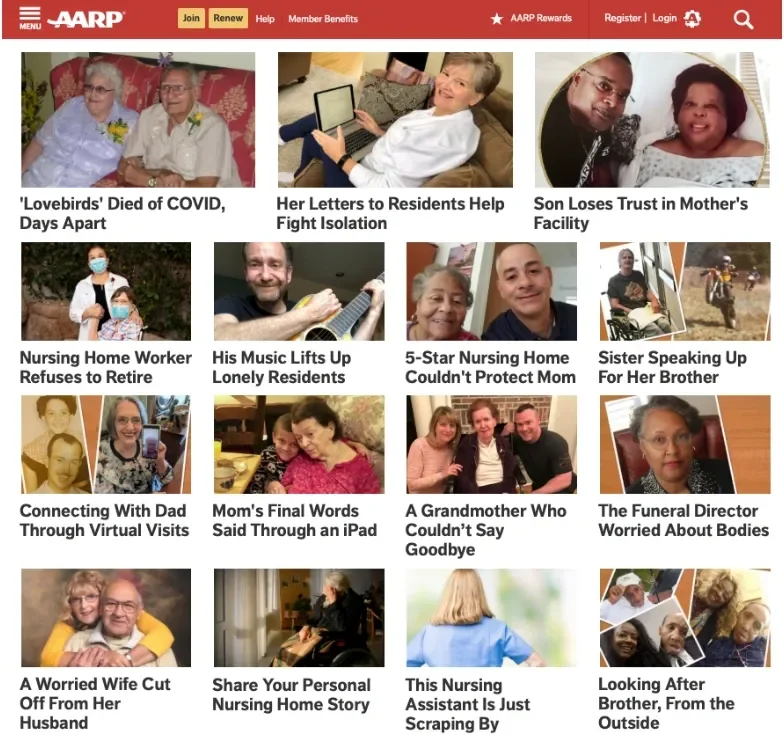
Images from the AARP website.
Culture And Narratives within Nursing
Prison facilities were not the only facilities facing uncertainty as COVID-19 spread across the globe. Nursing homes, their residents, residents' family members, and local funeral directors shared narratives of hope, grief, isolation, and disbelief. To capture narratives through headlines alone, AARP headlines read: "'Lovebirds' Died of COVID, Days Apart; Mom's Final Words Said Through an iPad; The Funeral Director Worried About Bodies; AARP Fights for Transparency in Care Facilities Amid Crisis" (AARP, 2022). Family narratives changed as Covid aggressively spread through long-term care facilities; "I didn't want it to happen now, but I did want them to go together" (Meyers, 2021), Meyers speaking about their parents dying days apart. "We were robbed. Mama was trapped in a petri dish, and we were shut out… Mama died alone, and my family will forever be scarred by this tragedy" (Lolley, 2020), Lonny and their family were unable to remove their mother from a nursing home while simultaneously being unable to visit her. "Sometimes you have to walk away and sit in your office and cry because you're helpless" (Williams, 2020). Williams, a funeral home director and owner, felt unsafe bringing bodies into the funeral home from nursing home facilities since the cause of death was unknown while simultaneously having friends and families returning to her funeral home either already grieving over a recent loss or returning among the deceased in a casket.
Not all narratives of the pandemic were of distress, sadness, or anger. The Send-A-Note program, developed by a religious nonprofit organization specializing in senior care services, allowed anyone living in one of the 166 facilities with these chat services to access the program. Nursing home residents and the chat volunteers developed new narrative forms of communication to help cope with the isolation those faced inside and outside long-term care facilities
Conclusion
In conclusion, the COVID-19 pandemic impacted the way we live our lives. Did everyone share the same pandemic narrative? The simple answer is no. Perhaps these changes in our daily routines, whether at work or home, caused our cultural narrative to evolve permanently. And if the pandemic caused a rapid narrative evolution within culture, how often has this happened during human history, and what are the impacts of long-term narrative change on us and our actions? Do our words change us?
Notes On Citations and F.A.T.E.
Each of the references listed below served as a foundational narrative or was consulted during the development of this written text by Selena Scola (3/2022), even if they were not directly cited in the final work.
Citations
Outbreak (1995) Official Trailer - Dustin Hoffman, Morgan Freeman Sci-Fi Movie. (2014, July 12) https://www.youtube.com/watch?v=Y5povsMKfT4
28 Days Later. (2022) In Wikipedia. https://en.wikipedia.org/w/index.php?title=28_Days_Later&oldid=1072920331
How American conservatives turned against the vaccine (2022, February 23) https://www.youtube.com/watch?v=sv0dQfRRrEQ
Daphna-Tekoah, S., Megadasi Brikman, T., Scheier, E., & Balla, U. (2020). Listening to Hospital Personnel's Narratives during the COVID-19 Outbreak. International Journal of Environmental Research and Public Health, 17(17), 6413. https://doi.org/10.3390/ijerph17176413
Daphna-Tekoah, S., Megadasi Brikman, T., Scheier, E., & Balla, U. (2020). Listening to Hospital Personnel's Narratives during the Covid-19 Outbreak. International Journal of Environmental Research and Public Health, 17(17), 6413. https://doi.org/10.3390/ijerph17176413
de Saint Laurent, C., Glăveanu, V. P., & Literat, I. (2021). Internet Memes as Partial Stories: Identifying Political Narratives in Coronavirus Memes. Social Media + Society, 7(1), 2056305121988932. https://doi.org/10.1177/2056305121988932
Heath, C., Sommerfield, A., & von Ungern-Sternberg, B. S. (2020). Resilience strategies to manage psychological distress among healthcare workers during the Covid-19 pandemic: a narrative review. Anaesthesia, 75(10), 1364-1371. https://doi.org/10.1111/anae.15180
Lennon, J. J. (2021, April 6). I'm Incarcerated. This Is My Covid Lockdown Story. The New York Times. https://www.nytimes.com/2021/04/06/magazine/prison-covid.html
Inside Nursing Homes: Real Stories During Coronavirus. AARP. Retrieved March 3, 2022, from https://www.aarp.org/caregiving/stories/inside-nursing-homes-during-coronavirus/
A Funeral Director Who's Picking Up Bodies —and Worries — From Nursing Homes. AARP. Retrieved March 3, 2022, from https://www.aarp.org/caregiving/stories/info-2020/coronavirus-nursing-home-profile-funeral-director.html
Ravitz, J. Watched Mom Decline From Coronavirus Through a Window. AARP. Retrieved March 3, 2022, from https://www.aarp.org/caregiving/stories/info-2020/coronavirus-nursing-home-profile-watching-mom-through-window.html
Moss, S. M., & Sandbakken, E. M. (2021). "Everybody Needs to Do Their Part, So We Can Get This Under Control." Reactions to the Norwegian Government Meta-Narratives on Covid-19 Measures. Political Psychology, 42(5), 881-898. https://doi.org/10.1111/pops.12727
Monasterio Astobiza, A. Science, misinformation and digital technology during the Covid-19 pandemic. HPLS 43, 68 (2021). https://doi-org.proxy.library.upenn.edu/10.1007/s40656-021-00424-4
Davis, M. (2017). "Is it Going to be Real?" Narrative and Media on a Pandemic. Forum: Qualitative Social Research, 18(1). http://www.qualitative-research.net/index.php/fqs/article/view/2768
Cecchi, D. (2021). Pandemic and the Fairy Tale Narrative. Aisthesis. Pratiche, Linguaggi E Saperi dell’estetico, 14(1), 37-43. https://doi.org/10.36253/Aisthesis-12499
The weird pandemic narrative. - Document - Gale OneFile: News. Retrieved February 24, 2022, from https://go-gale-com.proxy.library.upenn.edu/ps/i.do?p=STND&u=upenn_main&id=GALE%7CA686428529&v=2.1&it=r&sid=summon